What is AHAGAI and why am I doing this?
I did a brief podcast about what this is and what to expect [see below]. But in a nutshell, I’m trying to distill thousands of years of knowledge across cultures and time periods from across the world, to the most actionable points that can be used to accelerate personal and organizational growth. I’m using tools and techniques leveraging Generative AI to make this happen.
AHAGAI stands for Accelerated Habit Adoption with Generative AI
It is my framework for:
- Transforming how I approach personal growth in just 30 days.
- Researching, analyzing, and curating insights from multiple domains.
- Developing sustainable strategies to integrate these insights into daily life.
The first thing I did was do identify the top 100 books on self-improvement, across all knowledge domains, time periods and cultures. Then I distilled the concepts outlined in these books to their core tenets. Then I researched where they came from (i.e.; philosophy, strategy, techniques, etc.). I then set a time constraint for myself to 30 days for integrating them. I have 4 weeks, each with 5 days of different areas. So that’s 20 focus days. Then there are 2 days a week that I focus on integrating various AI frameworks, tools, and methods into my workflow. The reason for that is that I will use these AI tools to research and implement the concepts I am integrating, thus accelerating the process.
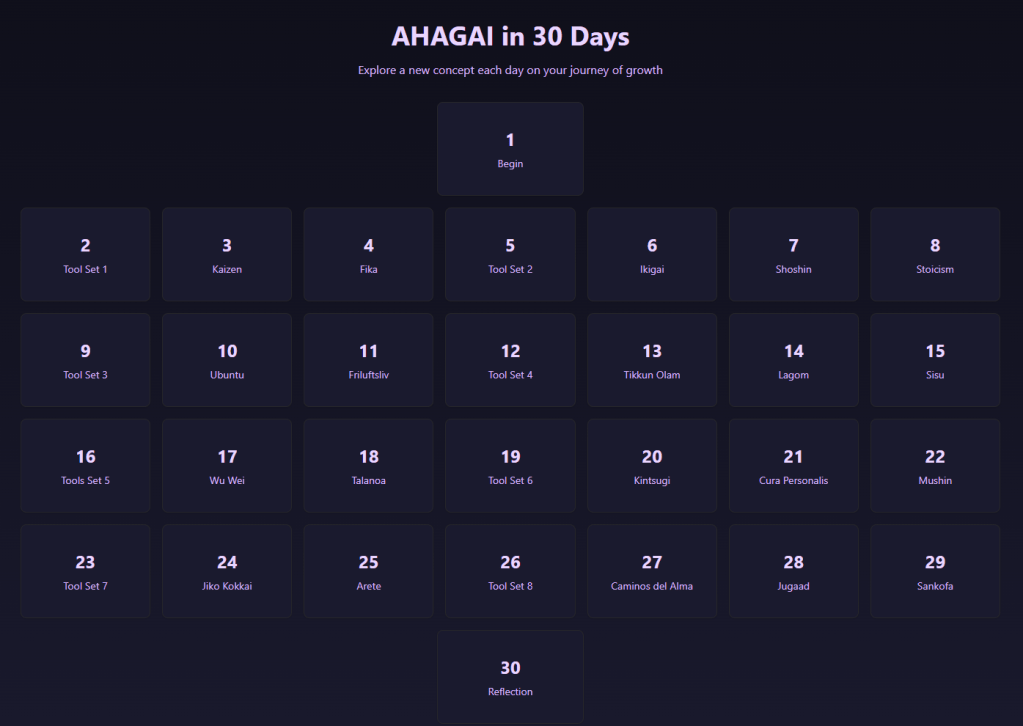
The last 2 days out of 30, are the 1st and last days.
- The first is about making oneself open to change and having the deliberate intention set for limitless transformation. No guardrails or constraints set.
- The last day is for reflection on the process, the learnings, what was the good, the bad, what can be improved, and what can be shared with others.
Day 1:
This was to get my bearings and determine the scope of the undertaking. Mental preparing for what comes next. I am starting this ad-hoc without any long pre-amble or forethought. It made me think about when I was about a time about 18 years ago, when we lived in Vancouver, and there was a marathon that passing by our house. Without hesitation I joined in without any preparation or plan and took my 4-year old daughter with my for an adventure. We went about 10K and finished that leg of the run. We didn’t do the entire marathon, but we dove in and were better for it in the end. This feels very much the same to me. No preparation, but a willingness to accept change without limitations. There is a big chance of failure, or not going the distance, but it’s an adventure and I want to see where this goes.
Day 2:
Now we get down to business. I did some research, put the output into spreadsheets, organized it, and then enriched the data with AI. That allowed me to narrow down the possible to the best options for growth. In this phase I used an excel plugin from Microsoft Garage (open-source side-show projects) called Excel Labs. It allowed me to make API calls to OpenAI with prompts, using source data from cells in excel.
Then I used this enriched spreadsheet as a source for building a software spec for an application that was going to help me with doing my AHAGAI. I then used a SaaS based no-code IDE platform called co.dev. It allowed me to build a minimum viable product using only natural language in about 30 minutes.
Over the next day, I would do 17 iterations, making minor incremental improvements along the way. The result is a published app that you can have a look at here: AHAGAI Calendar app.
Day 3:
This is where I start digging into the harder stuff. I researched Kaizen, which was a method of introspection and removal of waste, to optimize efficiency. It was developed in Japan after WWII as a means to make Toyota competitive with Ford, understanding that inefficiencies and waste can be masked by abundance of resources, such as time, space, money, raw materials. Japan was still recovering from WWII and did not have same circumstances that the US had, experiencing massive economic growth . They had to analyze everything and remove all that was waste, (called Muda), to experience the same sort of growth. Then perform small incremental improvements continually in every aspect of the organization. Provide agency to employees to be part of that process and let them create the solutions to help the organization with common sense and domain specific knowledge. It was important to see where work happened. The workplace (or gemba) was to be observed, then processes visualized. Things like Kanban boards, process-workflow maps and other methods were used to remove the Muda from every part of the organization. The process for focusing on a specific area that could have the most impact in the short term, is called a Kaizen Event.
A Kaizen event is done using the 5S methodology:
- Seiri (Sort – remove the unnecessary)
- Seiton (Set in order – Organize items for quick access)
- Seiso (Shine – Keep everything clean and tidy)
- Seiketsu (Standardize -Implement daily routines)
- Shitsuke (Sustain – Discipline, or continuous upkeep)
The cycle for implementing change in a Kaizen Event is PDCA.
- Plan – Identify and strategize
- Do – Implement small steps
- Check – Measure and review
- Act – Standardize or Adjust
This can be applied to any company and any workflow. However, the key to what I am doing is related to Generative AI. I looked high and low for books on Kaizen and Generative AI, but found none. So instead I co-authored one with AI.
I found that the best books on Kaizen were written by Masaaki Imai, a renowned Japanese organizational theorist and management consultant. Masaaki passed away in 2023 at the age of 92, so he didn’t have the opportunity to live through the current transformational era that we live in today.
So I created an AI agent that personified Masaaki, based on his body of work and writing style. I then said that the agent should also have a deep understanding of Generative AI and the various ways that Kaizen can be implemented through it.
- I used OpenAI GPT4o to create the table of contents for the book.
- I used Notion AI to create the structure and an organizational template so that it can be published in Amazon in both print and digital.
- I used OpenAI GPT4o1 to flesh out the individual chapters one at a time, with the output roughly 3000 words per chapter.
The process created 17 chapters, divided into 4 parts. I have taken the text from Notion and exported it as pdf, html, and markdown. I then open-sourced it and put it on Github. Have a look here.
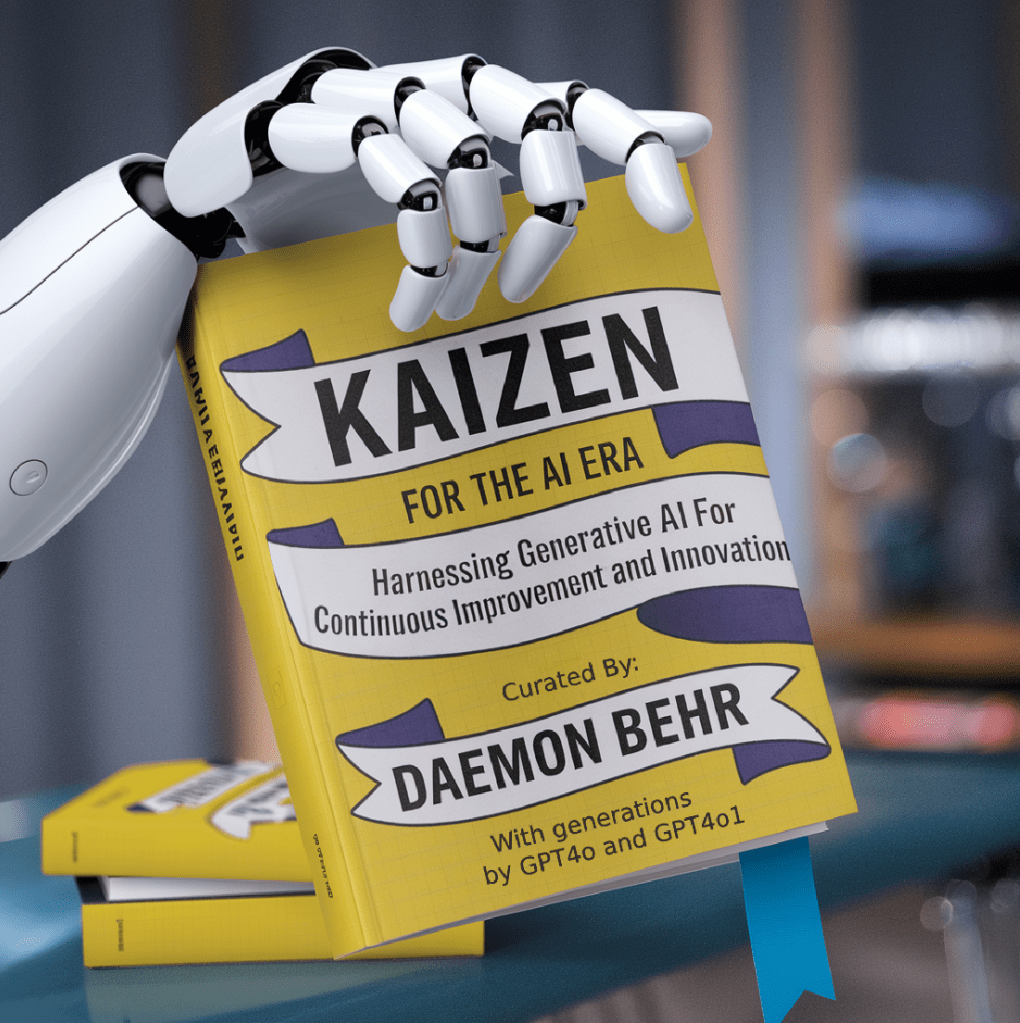
The image generated above was by Ideogram
This process has been really eye opening thus far and I’m sure there will be plenty more interesting stuff to see.. Stay tuned.
About the author

With 25 years of industry experience, Daemon Behr is a seasoned expert, having served global financial institutions, large enterprises, and government bodies. As an educator at BCIT and UBC, speaker at various notable events, and author of multiple books on infrastructure design and security, Behr has widely shared his expertise. He maintains a dedicated website on these subjects, hosts the Canadian Cybersecurity Podcast, and founded the non-profit Canadian Cyber Auxiliary, providing pro bono security services to small businesses and the public sector. His career encapsulates significant contributions to the IT and Cybersecurity community.
Other recent articles of note.





Discover more from Designing Risk in IT Infrastructure
Subscribe to get the latest posts sent to your email.
 Designing Risk in IT Infrastructure
One thought on “AHAGAI – Day 3 of 30 – Kaizen and the method of continual improvement in the era of AI”
Comments are closed.